
Can a Story Initiate Personal Growth?
December 4, 2011 by Quantum Publisher
Filed under BEST POSTS, Build Mind Power, Creativity, Feeling Positive, Health, Law of Attraction, Life Mastery, Mind Stretch, Prosperity, Success Insights
Comments Off on Can a Story Initiate Personal Growth?
 Did you by chance read The Celestine Prophesy?
If so, did you wonder how that book could end up on the NY Times Bestseller list for three years!
WHY did this happen? Dr Jill Ammon-Wexler here. I have spent years teaching mind power and personal growth to people from around the world — and before that I did the same in a clinical environment in California’s Silicon Valley.
And although I have developed many of the best personal development tools on the web, there is something I must still admin: WE LEARN MORE, AND LEARN MORE DEEPLY, FROM STORIES.
Here is a ell-written adventure fable that, Like Celestine Prophesy, will drop personal transformation right into the back of your mind:
Go read a sample from BOOK of the “Birth of a Warrior: The Dragon’s Gate” click here!
Can You BECOME a Genius?
August 1, 2011 by Quantum Publisher
Filed under BEST POSTS, Mind Power
Comments Off on Can You BECOME a Genius?
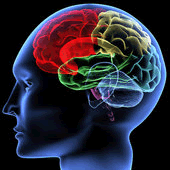 How to BUILD genius mind power
If your IQ is ataverage, hold on to your socks: Genius levels of mental processing ARE within your reach.
John von Neumann, the inventor of th least e computer, estimated that our brains hold two hundred and eighty quintillion bits of memory that’s 280, followed by 18 zeros. But most of today’s neuroscientists feel even this estimate is far too low.
A few short years ago scientists believed geniuses were born with brains that were somehow different from the rest of us. BUT — recent scientific research suggests that genius mind power is more the result of mental training not just genetic superiority.
Even today’s Einstein’s are now seen by neuroscientists as ordinary people who have simply consciously developed extraordinary genius mind power and focus.
How Genius is Developed
We don’t often think of the mind as a tool whose powers can be developed on such a dramatic level. But the good news is there are definite, proven-effective ways to develop your brain’s capacity to express genius mind power.
Modern neuroscientists and brainwave training experts claim that genius-level mental functioning is primarily all about connections.
Which connections? The ever-changing maze of connections among your neurons brain cells. The scientific evidence is this: The more you stimulate and challenge your brain, the more connections it is forced to create to enable your neurons can communicate with one another.
And the more interconnections you have between your brain’s neurons, the closer you move toward genius-level creativity and thinking! It really is primarily that simple.
Einstein’s Secret
As a child, Albert Einstein was seriously dyslexic and had great difficulty with both speech and reading. He was actually expelled from high school and flunked his first college entrance exam, although he finally did manage to complete his bachelor’s degree.
He then took a lowly job in the Swiss patent office. But then when he was only 26, he published his Special Theory of Relativity And sixteen years later he won a Nobel Prize.
Dr. Thomas Harvey, a pathologist on duty at Princeton Hospital when Einstein died in 1955, removed Einstein’s brain. Harvey studied it under a microscope over a 40-year period, but never found any differences from “normal” brains.
But in the early 1980s Dr Marian Diamond, a neuro-anatomist at the University of California at Berkeley, made some interesting discoveries. Her findings about brains in general revolutionized our ideas about what genius really is!
Diamond placed a group of rats in a very stimulating environment with ladders, swings, treadmills, and rat toys. She then confined a control group of rats to bare cages.
The rats in the stimulating environment lived to advanced ages the equivalent of 90 for mankind. But even more remarkable, Diamond found their brains had grown an amazing number of new connections between their neurons.
She had discovered the first hard evidence that higher intelligence could be created through mentally-stimulating exercise. And then when she examined sections of Einstein’s brain, she made the remarkable discovery that it WAS different from the average brain in one way. Like her super-stimulated rats, Einstein’s brain also had an unusually high number of experience-based neural interconnections.
Our brains can continue to grow in complexity right up to a very advanced age. Each challenge you present to your brain causes immediate physical changes no matter what your age.
A Plan of Action
Your brain’s inter-neural connections can potentially increase in number and complexity throughout your life. The more you learn, the more of these pathways you create. And the more you stimulate your brain, the sharper your memory and mental responses. The payoff is immeasurable, and can lead straight to genius mind power.
The most basic way to build genius mind power is to intellectually challenge and exercise your brain. You can create healthy new neural networks by learning a new skill or a second language, or learning to play a musical instrument.

The QUANTUM MIND PROGRAM.A supercharged online training to create the actual brain states of self-achieved people like self-made millionaires in your own brain. An amazing, proven-effective experience.=> MORE INFO!
posted by Jill Ammon-Wexler
Amazing Success
How to DOUBLE Your Brain Power
April 22, 2011 by Quantum Publisher
Filed under BEST POSTS, Mind Stretch
Comments Off on How to DOUBLE Your Brain Power
 You CAN Double Your Brain Power
Think you have an “average” or perhaps an “above average” mental capacity?
Actually you have far more brain power than you can begin to imagine. You have close to, or perhaps even beyond, *genius* brain power potential! You say you don’t believe me?
The past 20 years could well be called “the decade of the brain.” Neuroscience now has the means of observing a healthy living brain in action. But still, trying to define our ultimate brain power capacity is like trying to place your finger on a globule of mercury.
The human mind is infinitely complex and subtle. And your amazing mind is no exception!
Your Amazing Brain Power
Your brain contains 1,000,000,000,000 individual nerve cells (neurons). But this figure is even more astounding when you consider that each nerve cell can interact with at least as many as 100,000 other nerve cells.
Then … if we calculate the potential capacity of your brain cells to make interconnections — the resulting number would be at least 10.5 million kilometers long.
How Much Brain Power Are YOU Using?
No known person has even approached using their full brain power or mental capacity. The human brain is virtually limitless.
It was once estimated we use about 10% of our mental potential. Today neuroscience has dropped that estimate to less than one percent. And even that figure seems overly optimistic!
Your “Thinking Cap” You’ve likely heard the expression “thinking cap.” That slang term refers to our brain’s cerebral cortex — the “cortical grey matter” neuroscientists consider the source of our thinking capacity.
Your cortex is actually split into two separate sides connected by a fantastically dense and complex highway of nerve fibers called the “corpus collosum.”
In most people, the left side of the cerebral cortex deals with logical matters — words, numbers, reasoning, and analysis. It spends a lot of time in the “beta” brainwave range. The right side of your cerebral cortex, on the other hand, deals with imagination, images, color, day-dreaming, visualization, and pattern recognition. It tends to focus quite a bit in the “alpha” brainwave range so highly developed in meditators.
Are You Right-Brained OR Left-Brained?
There’s a common assumption that most people are either right-brained OR left-brained.
If that’s true, then we must assume that the great scientific genius Albert Einstein was left-brained — and the great creative master of photography Ansel Adams would then have been right-brained.
But was this the case?
Nope. An examination of the notebooks of Albert Einstein and Ansel Adams pokes huge holes in this common theory. In fact, Einstein credited his greatest scientific insights not to left-brain logic — but rather to his right-brain highly creative daydreaming and brain power.
And Ansel Adams credited his greatest art photographs not to his right-brain artistic “eye” — but rather to his left-brain detailed analytical note taking.
Actually – our most powerful and expansive mental activities are those using *both sides* of our cortex.
When you describe yourself as primarily creative or intuitive (right-brained), or analytical and logical (left-brained), you are just describing the side of the cortex you have most successfully developed. With the right nurturing, the other side of your cortex can also flourish and develop!
This has the potential to *double* your mind power!
Immediately DOUBLE Your Brain Power
There’s a simple, but powerful, way for you to immediately refine the non-dominant side of your cortex and double your brain power. Great athletes do it. So do top executives, famous artists, and people from all walks of life who seek to excel in their lives.
On first reading, the following solution may seem too simple to be effective. Just give it a try, and you’ll be amazed at the expanded depth of your mental capacity.
The solution? If you’re analytical — encourage yourself to daydream. And if you’re instead predominantly creative — encourage yourself to begin to logically analyze your creative efforts. Activate your mind and ask yourself “what if.” And… begin to pay more attention to your mental wanderings.
Experience THE QUANTUM MIND™!

The author of this article is the scientific director of something you NEED to learn more about. Go check out How she shows the lucky few how to actually BUILD MIND POWER => Amaze Yourself!
Posted by Jill Ammon-Wexler
Amazing Solutions